About 14 Day Rapid Soup Diet Official Website
We scanned foodsthatslim.com for several indicators, and this page contains a direct, self-contained contradiction worth addressing before anything else.
The headline promises losing “up to 17 pounds in 7 days,” and testimonials describe losses of 54 and 87 pounds. But the page’s own small-print FTC-mandated disclaimer, required on this kind of sales page, states plainly that “most men and women who strictly follow the program may lose 1 to 1.5 pounds a week” and that “the typical results for losing weight is zero” for most buyers, since most people never follow through. The dramatic headline claims and the page’s own legally required fine print directly contradict each other.
The page also shows clear signs of being built from a reused template: the main branding is “Flat Belly Soup Diet,” but the copyright footer names a different brand (“KetoSoupDetox.com”), the FTC disclaimer refers to “14-Day Rapid Soup Diet” users, and a separate section references selling “the digital copy of the 10-Day Fast Soup Detox,” three different product names on one page. A cited “expert” is also referred to as both “Dr. Hass” and “Dr. Shah” within the same article, with no full name, credentials, or affiliated institution given for either.
| Positive Reviews | Negative Reviews |
|---|---|
| Cites some real, checkable general sources (NIH, PNAS, PubMed) alongside its claims | The page’s own small-print disclaimer admits typical results are 1-1.5 lbs/week, directly contradicting headline claims of “17 pounds in 7 days” |
| Digital delivery means instant access with no shipping wait | The page mixes at least three different product names (“Flat Belly Soup Diet,” “14-Day Rapid Soup Diet,” “10-Day Fast Soup Detox”) and two different names for the same cited “expert” |
| A 60-day money-back guarantee is clearly stated | The core “burns more calories digesting it than it contains” claim reflects a long-debunked nutrition myth, not established science |
I’ve reviewed a lot of rapid weight-loss diet products in this series, and this one stands out for how directly its own fine print contradicts its headline promises, a rare case where the page essentially admits, in legally required language, that its main marketing claims aren’t what most buyers should expect.
Is 14 Day Rapid Soup Diet legit? This analysis looks at the central “negative calorie” claim, a concerning comparison to a real prescription medication, and what the page’s own disclaimer actually says.
What is 14 Day Rapid Soup Diet?
14 Day Rapid Soup Diet (marketed under several names, including “Flat Belly Soup Diet”) is a digital diet plan built around homemade soups containing “glucosinolate” compounds, promoted as producing rapid, effortless fat loss without calorie counting.
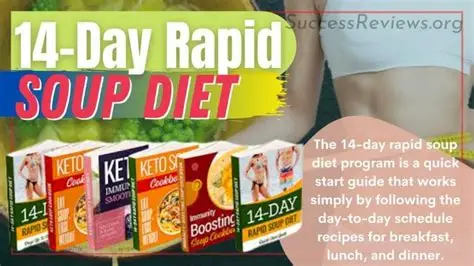
- Format: Digital guide plus six bonus recipe collections
- Price: $15, discounted from a listed $69
- Regulatory Status: The page includes a standard disclaimer stating it’s not a substitute for professional medical advice; not a licensed medical or nutritional treatment
What’s Inside 14 Day Rapid Soup Diet
Based on the official site, the program includes:
- The Core Soup Protocol – a meal plan built around “glu-food” soups for lunch and dinner
- Bonus: Fastest Fat-Burning Soups Cookbook – 30 additional recipes
- Bonus: Fat-Burning Comfort Soups Cookbook
- Bonus: Fat-Burning Breads – low-carb bread recipes
- Bonus: Fat-Burning Low-Carb Soup Cookbook
- Bonus: Quick Start Guide and Slow Cooker Soups Cookbook
Glucosinolates are real compounds found in cruciferous vegetables (broccoli, cabbage, kale) with genuine research behind some health benefits, that part isn’t invented. What isn’t supported by legitimate nutrition science is the claim that any soup “burns more calories digesting it than your body takes in,” a version of the “negative calorie food” myth that registered dietitians and nutrition researchers have repeatedly debunked; no ordinary food, however prepared, has a thermic effect large enough to produce net calorie loss this way.
How 14 Day Rapid Soup Diet Is Marketed to Work
The page claims an underperforming liver, affecting “80% of women and men over 40,” traps toxins in fat tissue and prevents weight loss, and that “glu-foods” detoxify the liver and activate the same GLP-1 hormone pathway as Ozempic, a real, FDA-approved prescription medication.
This comparison deserves direct scrutiny: Ozempic (semaglutide) works through a specific, well-studied pharmacological mechanism with extensive clinical trial data behind its effects on appetite and blood sugar. Claiming a vegetable soup produces comparable results through the same hormonal pathway is a significant medical claim without the kind of evidence that would support it, and it’s the sort of comparison that could reasonably lead someone to delay or avoid appropriate medical evaluation for a metabolic or weight-related health concern.
14 Day Rapid Soup Diet: What’s Claimed as Benefits
Based on the official site, the stated benefits are:
- Rapid, Effortless Weight Loss – the central marketed claim
- No Calorie Counting or Hunger – positioned as more sustainable than restrictive diets
- Works “At Any Age” – no age-related limitations claimed
- Long Refund Window – a 60-day guarantee
14 Day Rapid Soup Diet Cons
Before buying, there are real concerns worth weighing.
- Contradicts Its Own Disclaimer: headline claims of losing up to 17 pounds in a week directly conflict with the page’s own small-print admission that typical results are 1-1.5 pounds weekly.
- False “Negative Calorie” Premise: the core mechanism claimed for the soup isn’t supported by nutrition science.
- Unsupported Medical Comparison: claiming equivalence to a prescription GLP-1 medication is a significant, unsupported health claim.
- Multiple Product Names on One Page: “Flat Belly Soup Diet,” “14-Day Rapid Soup Diet,” and “10-Day Fast Soup Detox” all appear on the same page, alongside two different names for the same cited “expert.”
- Unverifiable Expert Citations: “Dr. Hass” and “Dr. Shah” are given no full name, credentials, or institutional affiliation.
Is 14 Day Rapid Soup Diet a Scam?
You would likely receive real digital recipe content if you order, and the underlying soup recipes themselves are probably reasonable, low-calorie meals, not fabricated.
But the marketing built around them has real, specific problems:
- The page’s own legally required disclaimer contradicts its headline weight-loss claims directly
- The “negative calorie” premise isn’t supported by nutrition science
- Comparing the program’s effects to a prescription medication is an unsupported claim that could discourage appropriate medical care
- Evidence of a reused, multi-branded template undermines confidence in how carefully this specific page was constructed
If you’re interested in soup-based meal planning generally, that’s a reasonable approach many nutrition professionals would support as part of a balanced diet. Treat the specific rapid-weight-loss and Ozempic-equivalent claims as unsupported marketing, and rely on the page’s own small-print disclaimer, 1-1.5 pounds per week, as a more realistic expectation than the headline promises.
Conclusion
Looking at 14 Day Rapid Soup Diet overall, its most telling flaw is built into the page itself: a legally required disclaimer admitting typical results are a small fraction of the dramatic weight-loss figures used to sell the product, alongside a “negative calorie” premise that nutrition science doesn’t support and a comparison to a real prescription medication that isn’t backed by comparable evidence.
Evidence of a reused template, three different product names and two names for the same cited expert, further suggests this page wasn’t built with careful, product-specific attention.
If you decide to try the actual recipes, treat them as a reasonable, low-calorie meal plan at most, not a scientifically validated rapid weight-loss method, and rely on the 1-1.5 pound weekly estimate the page’s own disclaimer provides rather than its headline claims.