About Power Efficiency Guide Official Website
We scanned powerefficiencyguide4all.com for several indicators and think the website is one to approach with real caution.
The domain is about seven years old, registered in November 2018, but it does not appear on the official vendor’s own affiliate hub as a recognized promotional domain, which points to this specific page being an affiliate’s own cloned copy of the sales page rather than a vendor-operated site. A third-party scanner gives it a trust score of 0 out of 100, rating it “very likely unsafe,” and notes it shares a server with other unreliable websites along with at least one user report calling it a possible scam, though it found no active malware or phishing payload. WHOIS ownership is hidden behind a privacy service, and traffic is very low, consistent with a page fed almost entirely by paid affiliate clicks rather than organic visitors. Checkout runs through ClickBank, a real payment processor, with pricing shown as a discounted $49 marked down from $149, and other resellers consistently cite ClickBank’s standard 60-day money-back guarantee, though the exact refund terms are not spelled out on this specific page.
| Positive Reviews | Negative Reviews |
|---|---|
| ClickBank checkout provides a real payment processor with an independent 60-day dispute mechanism | A third-party trust scan rates this specific domain 0/100, “very likely unsafe,” and flags it as sharing a server with other unreliable sites |
| The core “Power Efficiency Guide” product has been sold for roughly a decade as part of a known ClickBank offer family | The named creator, “Mark Edwards,” could not be verified as a real person, and the same name is used as a generic affiliate-contact address across several unrelated product titles |
| Digital delivery means immediate access to the guide after purchase | The central claim, a self-recharging device that cuts electricity bills to nearly nothing, describes a perpetual-motion mechanism that conflicts with established physics |
Power Efficiency Guide is a digital guide credited to “Mark Edwards,” built around a device described in independent reviews as one that “uses some external energy to start working then uses some of the generated energy to recharge itself,” pitched as needing no sun, wind, gas, or ongoing maintenance. The sales page itself leans on a suppressed-technology narrative, framing the discovery as something “electric companies have already gathered an army of lawyers to take down,” a storytelling device common across this entire category of product rather than something specific to this one guide.
What is more concerning is what independent research turned up: this same “Power Efficiency Guide” title is sold across a family of at least six related offers from one vendor umbrella, including Easy DIY Power Plan, Quick Power System, and an “Overunity Generator,” and the specific domain used for this review is not one of the vendor’s own listed promotional domains, indicating it is a separately cloned affiliate landing page. A genuinely independent forum discussion found in this research explicitly calls the product’s mechanism a “perpetual motion machine” and criticizes the extraordinary claim of reducing bills to nearly zero. That combination of an unverifiable creator, a rotating-domain sales structure, and a physically implausible core claim is why people ask: is Power Efficiency Guide legit?
What is Power Efficiency Guide?
Power Efficiency Guide is a digital instructional guide credited to “Mark Edwards,” describing how to build a small DIY device claimed to generate or recycle electricity to significantly reduce a household’s power bill.
- Key Features: Step-by-step build instructions for a described self-recharging power device, sold as a downloadable digital guide
- Format: Digital delivery, downloadable PDF/guide format, no physical product shipped by the vendor
- Regulatory Status: Sold as an educational DIY guide; its specific electricity-savings and device-performance claims are not independently verified or evaluated by any regulatory or engineering body
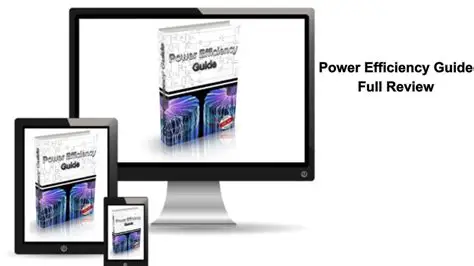
Key Features of Power Efficiency Guide
- Step-by-step device build guide – the core instructional content describing how to assemble the described device
- Low stated materials cost – other resellers cite roughly $100 in parts needed to build the device at home
- Digital instant delivery – guide is downloadable immediately after purchase through ClickBank
- 60-day guarantee – backed by ClickBank’s standard refund system, per third-party resellers, though not detailed on this specific page
How Power Efficiency Guide Claims to Work
Key mechanisms described include:
- Building a small device using an external energy source to begin operating
- The device then using a portion of its own generated output to recharge and keep running
- Continuing to supply power indefinitely without sun, wind, gas, or ongoing maintenance
A device that uses part of its own output to sustain its own operation indefinitely, producing more usable energy than it consumes, is what is known as a perpetual motion or “over-unity” claim. This directly conflicts with the first and second laws of thermodynamics, the well-established physical principles that energy cannot be created from nothing and that no real system converts energy without some loss. This is a matter of settled physics rather than a personal opinion about the product, and it applies to the mechanism as described regardless of who is selling it.
Power Efficiency Guide Benefits
- Real payment processor – ClickBank backs the purchase with an independent refund and dispute mechanism
- Long-running offer – this general product concept has circulated in the ClickBank marketplace for roughly a decade rather than appearing overnight
- Low entry price – a discounted $49 price and modest stated materials cost limit the financial exposure of trying the guide
- Digital instant access – buyers can review the guide’s actual content quickly after purchase rather than waiting on shipping
Power Efficiency Guide Cons
- The named creator, “Mark Edwards,” could not be verified as a real person, and the same name and email are used as a generic affiliate contact across an entire family of unrelated product titles
- A third-party trust scan rates this specific domain 0 out of 100, flagging it as sharing server space with other unreliable sites
- The product is sold across a rotating family of similarly branded offers and cloned affiliate domains rather than one accountable vendor site
- The central device claim describes a perpetual-motion mechanism that conflicts with established laws of physics
- Independent, genuinely neutral discussion of this product is scarce, and most available “reviews” are themselves affiliate content promoting the same offer
- Widely cited savings figures, such as a “70% bill reduction,” trace back to paid press-release distribution services rather than independent or verified data
Is Power Efficiency Guide a Scam?
Power Efficiency Guide is sold through a real, established payment processor with a standard refund mechanism, and the broader “DIY energy guide” concept has been sold under this general branding for roughly a decade rather than being a brand-new, unproven offer.
A few things are still worth real caution:
- The complete inability to verify the creator’s identity makes it impossible to evaluate any personal claims of engineering or invention behind the guide
- The specific domain reviewed here scores at the bottom of a third-party trust scale and is not part of the vendor’s own recognized domain list
- The core device mechanism, as described in independent sources, is a textbook perpetual-motion claim that established physics says cannot work as advertised
- Widely repeated savings percentages are not backed by independent or verifiable data
My verdict: whatever the guide’s written content actually contains, a device claimed to recharge itself indefinitely and slash electricity bills to nearly zero describes something that current science says is not possible, so that specific promise deserves serious skepticism regardless of the guide’s price or refund policy. Anyone considering this purchase should rely on the 60-day ClickBank guarantee to evaluate the actual content rather than expecting the device itself to perform as described.
Conclusion
Power Efficiency Guide is a long-running ClickBank digital guide describing a DIY device claimed to generate and recycle its own power, credited to an unverifiable creator and sold across a family of similarly branded, rotating affiliate domains. Independent discussion of the product explicitly identifies its core mechanism as a perpetual-motion claim, which conflicts with established physics.
If you decide to purchase this guide, treat the electricity-savings and self-recharging claims as unproven marketing rather than demonstrated science, verify you are buying through a working ClickBank checkout before entering payment details given the cloned-domain pattern, and use the 60-day guarantee to evaluate the actual written content for yourself.